Transcranial Magnetic Stimulation
A noninvasive form of neuromodulation that uses focused magnetic pulses to stimulate specific brain regions — offered for appropriate clinical indications following an individualized medical evaluation.
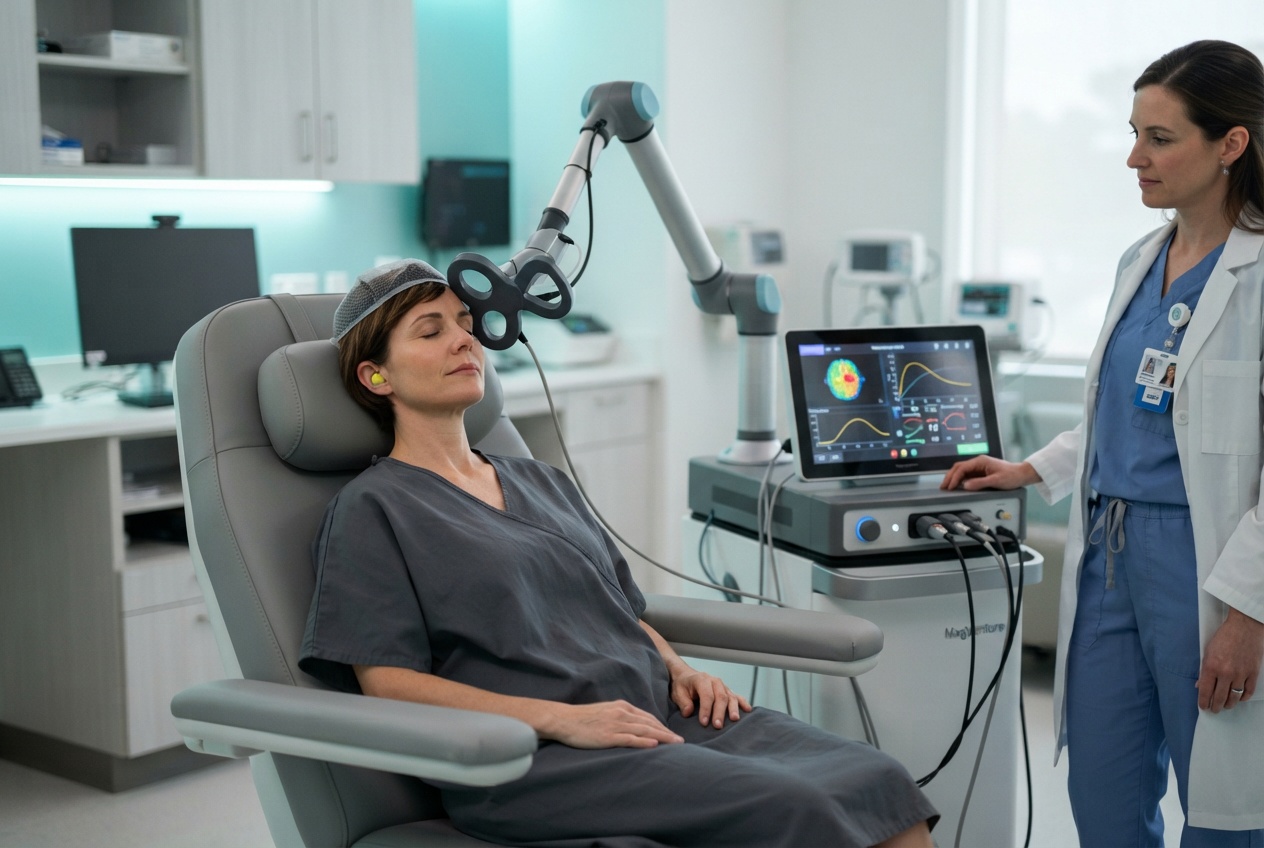
How TMS works
Transcranial magnetic stimulation uses an electromagnetic coil placed against the scalp to generate brief magnetic pulses. These pulses pass painlessly through the skull and induce small electrical currents in targeted areas of the brain's surface, influencing the activity of neural circuits involved in mood and other functions. When pulses are delivered repeatedly over a series of sessions, this is called repetitive TMS (rTMS).
TMS does not require anesthesia or sedation, and patients remain awake and alert throughout each session. It is distinct from electroconvulsive therapy (ECT) and does not induce seizures as part of treatment.
Established and emerging uses
It is important to understand the difference between uses supported by regulatory clearance and uses still being studied.
Established indications
Certain TMS devices are FDA-cleared for specific indications, most notably major depressive disorder in adults who have not responded adequately to antidepressant medication. Some devices are also cleared for obsessive-compulsive disorder, smoking cessation and certain migraine presentations. Clearances are device-specific.
Emerging & investigational
TMS is not FDA-cleared for the treatment of traumatic brain injury, concussion, post-concussion syndrome or PTSD. Research into these applications is ongoing, and results are not yet conclusive. Any discussion of such uses is clearly identified as off-label or investigational.
Depression is common after traumatic injury. When a patient with a brain injury history also meets criteria for major depressive disorder that has not responded to medication, TMS may be considered for the depression itself — following careful medical evaluation of safety factors related to the injury.
Who may be a candidate
- Adults diagnosed with major depressive disorder who have not achieved adequate benefit from antidepressant medication
- Patients who have experienced intolerable side effects from medication
- Individuals who have completed a full medical and psychiatric evaluation and safety screening
Because a history of brain injury, seizures or certain implanted devices can affect eligibility and risk, every candidate undergoes thorough screening. Patients with metal in or near the head (other than standard dental work), cochlear implants or certain implanted stimulators are generally not candidates.
The TMS treatment process
Medical and psychiatric evaluation
Review of diagnosis, treatment history, injury history, medications and seizure risk factors to determine whether TMS is appropriate and safe.
Mapping session
At the first treatment, the clinician locates the motor area of the brain and determines your individual motor threshold, which is used to set the stimulation strength and target position.
Treatment course
Sessions are typically scheduled on weekdays over several weeks. Session length depends on the protocol used.
Progress monitoring
Symptoms are measured with standardized scales at regular intervals so that progress can be reviewed and the plan adjusted.
What patients can expect
During a session you sit in a padded chair while the coil rests against your head. You will hear clicking sounds — earplugs are provided — and feel a tapping sensation on the scalp. You can drive yourself to and from appointments and return to normal activities immediately.
The most common side effects are scalp discomfort at the treatment site and headache, which typically lessen over the first weeks. Seizure is a rare but serious risk, which is why careful screening is required. Response to TMS varies, and benefit cannot be guaranteed.
Frequently asked questions
Is TMS a treatment for traumatic brain injury or concussion?
TMS is not FDA-cleared to treat TBI, concussion or post-concussion syndrome. Research is ongoing. At NTI, TMS is considered for established indications — such as treatment-resistant major depression — that may occur in patients who have experienced trauma.
Is TMS used for PTSD?
TMS is not FDA-cleared for PTSD. Studies are exploring its potential, but evidence-based psychotherapies remain first-line treatment for PTSD. Our trauma therapy program offers these approaches.
Does TMS hurt?
Most people describe a tapping or knocking sensation on the scalp. Some experience discomfort or headache, especially in early sessions, which usually decreases over time.
Is TMS safe for someone with a history of head injury?
A history of brain injury may increase seizure risk and requires careful individual evaluation. Some patients will not be candidates. This is why a thorough medical screening is always completed before treatment.
Will I need to stop my medications?
Many patients continue their medications during TMS. Some medications can affect seizure threshold, so your full medication list is reviewed beforehand. Do not make changes without guidance from your prescriber.